
SAP Logistics Module Selector
Select the primary challenges your business faces to discover the essential SAP modules for your operations.
Recommended Solution
Select challenges on the left to see your recommended SAP configuration.
Imagine a global retailer selling millions of items daily. Without a central nervous system, their inventory would vanish into thin air, shipments would miss deadlines, and customers would leave angry reviews. This chaos is exactly what SAP prevents. But what is SAP in logistics, really? It’s not just another software tool you install on your laptop. It is the digital backbone that connects every step of your supply chain-from raw material procurement to final delivery-at lightning speed.
If you are managing a complex operation, understanding SAP isn't optional anymore; it's survival. This guide cuts through the corporate jargon to explain how SAP actually works in the real world, which modules matter most for logistics, and whether the investment makes sense for your business in 2026.
Key Takeaways
- SAP in logistics refers to a suite of integrated modules (like MM, SD, EWM) that manage procurement, sales, and warehousing in real-time.
- The core benefit is end-to-end visibility, eliminating data silos between purchasing, production, and shipping teams.
- SAP Extended Warehouse Management (EWM) is the gold standard for complex warehouse operations, offering automation and slotting optimization.
- Implementation is costly and complex, typically requiring significant upfront investment and change management, but ROI comes from reduced errors and faster throughput.
- SAP S/4HANA is the current generation platform, moving away from traditional databases to in-memory computing for instant analytics.
The Core Problem: Why Supply Chains Need a Central Brain
Before diving into acronyms, let’s look at why companies like Amazon, BMW, or Coca-Cola rely on SAP. In the past, logistics was fragmented. The purchasing team used one spreadsheet, the warehouse used another system, and finance had a third. When a shipment arrived late, nobody knew why until weeks later. Was it a supplier delay? A customs hold? A truck breakdown?
SAP solves this by creating a single source of truth. Every transaction-whether it’s buying steel, storing boxes, or invoicing a customer-is recorded instantly across all departments. If a supplier delays raw materials, the production schedule adjusts automatically, and the sales team can proactively inform customers about potential delays. This integration reduces guesswork and stops costly mistakes before they happen.
Decoding the Alphabet Soup: Key SAP Logistics Modules
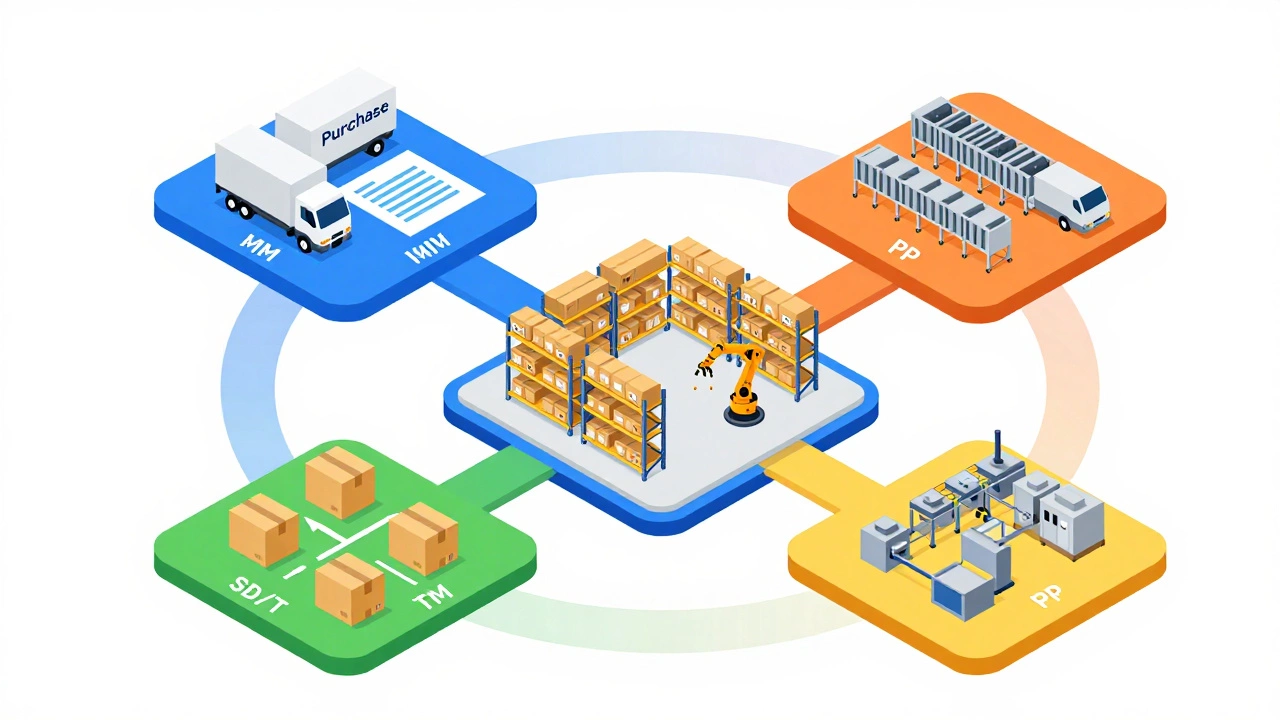
When people ask "what is SAP in logistics," they are usually referring to specific modules within the broader SAP ERP ecosystem. You don’t use all of them; you pick what fits your business model. Here are the heavy hitters:
- Materials Management (MM): Think of this as the procurement engine. It handles everything from finding suppliers and issuing purchase orders to receiving goods and verifying invoices. It ensures you never run out of stock or overpay for materials.
- Sales and Distribution (SD): This module manages the outbound side. It processes customer orders, checks credit limits, plans deliveries, and generates bills. It connects directly with MM so that when an order is placed, inventory is reserved immediately.
- Extended Warehouse Management (EWM): For businesses with complex warehouses, basic inventory tracking isn’t enough. EWM provides detailed control over storage locations, picking strategies, labor management, and even robotic automation. It tells a forklift driver exactly where to put a pallet and the fastest route to pick an order.
- Transportation Management (TM): This handles the movement of goods between points. It optimizes routes, consolidates shipments to save fuel, and manages carrier contracts. It answers questions like, "Should we ship via rail or truck?" based on cost and speed.
- Production Planning (PP): While technically manufacturing, PP is vital for logistics because it dictates what needs to be moved and when. It aligns material availability with production schedules.
How SAP Transforms Daily Logistics Operations
Let’s get concrete. How does SAP actually change your day-to-day work? Consider these three scenarios:
1. Real-Time Inventory Visibility
In a non-SAP environment, you might think you have 500 units of a product in Stock A. But actually, 100 are damaged, 50 are reserved for a VIP client, and 50 are still being unloaded. With SAP, the system shows you the available-to-promise quantity instantly. This prevents overselling and keeps customers happy.
2. Automated Procurement Cycles
When inventory drops below a predefined safety stock level, SAP can automatically generate a purchase requisition. Once approved, it sends a purchase order to the preferred vendor. When goods arrive, the warehouse scans them, and the system updates inventory and triggers payment processing. No manual emails, no lost paperwork.
3. Optimized Warehouse Slotting
SAP EWM analyzes historical data to determine the best place to store items. Fast-moving products are placed near packing stations to reduce walking time. Heavy items go to lower racks. This simple optimization can cut picker travel time by up to 30%, significantly boosting throughput during peak seasons.
SAP S/4HANA: The Modern Platform
You’ll often hear about SAP S/4HANA. This is SAP’s latest enterprise resource planning suite, built on the HANA in-memory database. Why does this matter for logistics?
Traditional databases store data on disk and retrieve it slowly. HANA keeps data in RAM (memory), allowing for instant calculations. Instead of waiting hours for a nightly report on global inventory levels, managers can see live dashboards updating every second. This speed enables predictive analytics-like forecasting demand spikes based on social media trends or weather patterns-allowing logistics teams to react proactively rather than reactively.
The Reality Check: Costs and Challenges
SAP is powerful, but it’s not without drawbacks. Before committing, consider these factors:
- High Implementation Cost: Licensing, consulting fees, and hardware/cloud costs can run into millions for large enterprises. Small businesses may find SAP Business One more affordable, but it lacks the depth of full SAP ERP.
- Complexity and Learning Curve: SAP requires specialized training. Employees need to learn new workflows, and IT teams must maintain the system. Poor adoption can lead to resistance and errors.
- Rigid Processes: SAP enforces best practices, which means you often have to adapt your business processes to fit the software, not the other way around. This can be disruptive if your current methods are highly customized.
- Ongoing Maintenance: Regular updates, security patches, and performance tuning require dedicated resources or a managed service provider.
| Feature | SAP Integrated Suite | Standalone WMS/TMS |
|---|---|---|
| Data Integration | Seamless, real-time sync across all departments | Requires APIs/integrations; risk of data lag |
| Implementation Time | Long (6-18 months typical) | Short (weeks to months) |
| Scalability | Highly scalable for global operations | Limited by individual tool capabilities |
| Total Cost of Ownership | High initial, lower long-term maintenance if optimized | Lower initial, potentially higher integration costs over time |
| Analytics Depth | Enterprise-wide insights with predictive modeling | Focused on specific functional area only |

Who Should Use SAP in Logistics?
SAP isn’t for everyone. If you’re a small local courier service, a lightweight TMS might suffice. But SAP shines for:
- Large Manufacturers: Companies with complex BOMs (Bill of Materials) and multi-tier supply chains.
- Global Retailers: Businesses needing to synchronize inventory across dozens of countries and currencies.
- Third-Party Logistics Providers (3PLs): Firms managing multiple clients’ goods simultaneously require robust tenant separation and billing features found in SAP.
- Companies Facing Rapid Growth: If your current systems are breaking under load, SAP provides the structure to scale efficiently.
Future Trends: AI and Sustainability in SAP Logistics
As we move through 2026, SAP is integrating more AI-driven tools. Imagine a system that automatically renegotiates freight rates based on market fluctuations or predicts equipment failure in your warehouse robots before they break down. Additionally, sustainability is no longer optional. SAP modules now track carbon footprints per shipment, helping companies meet regulatory requirements and consumer expectations for green logistics.
Getting Started: A Practical Roadmap
If you decide SAP is right for you, here’s how to approach it:
- Assess Your Needs: Don’t buy the whole package. Identify pain points-is it procurement, warehousing, or transportation?
- Choose Cloud vs. On-Premise: Most new implementations favor SAP S/4HANA Cloud for faster deployment and automatic updates.
- Partner with Experts: Hire certified consultants who understand your industry. Generic implementation leads to generic results.
- Plan for Change Management: Train staff early. Involve end-users in testing to ensure the system fits their workflow.
- Start with a Pilot: Roll out in one region or department first to iron out kinks before global expansion.
Is SAP only for large corporations?
While SAP is famous for serving Fortune 500 companies, it offers solutions for mid-sized businesses too. SAP Business ByDesign and SAP Business One are tailored for smaller organizations. However, the full power of SAP Logistics (MM, SD, EWM) is typically leveraged by larger enterprises with complex supply chains.
How much does implementing SAP Logistics cost?
Costs vary wildly based on scope. A cloud-based implementation for a mid-sized company might range from $100,000 to $500,000 annually including licensing and services. Large-scale global deployments can exceed $10 million. Always factor in hidden costs like data migration, training, and ongoing support.
What is the difference between SAP WM and SAP EWM?
SAP WM (Warehouse Management) is the older, simpler module suitable for basic storage needs. SAP EWM (Extended Warehouse Management) is the modern, advanced version supporting complex processes like cross-docking, wave management, labor tracking, and integration with automated storage and retrieval systems (AS/RS). Most new projects choose EWM.
Can SAP integrate with other logistics software?
Yes, SAP has robust integration capabilities via APIs and middleware platforms like SAP Integration Suite. It can connect with carrier portals, e-commerce platforms (Shopify, Magento), and specialized IoT devices for real-time tracking.
How long does it take to implement SAP Logistics?
A typical implementation takes 6 to 18 months. Simple cloud rollouts might finish in 4-6 months, while complex global transformations with customizations can take years. Proper project management and clear scope definition are critical to staying on schedule.