SAP EWM Suitability Analyzer
Check the boxes that apply to your current warehouse operations.
Ready to Analyze
Select your operational characteristics and click "Analyze Fit" to see if SAP EWM is recommended for your scenario.
You’re staring at a complex supply chain problem, and someone suggests SAP is the answer. But here’s the real question: Does SAP actually *do* warehouse management, or is it just another enterprise resource planning giant trying to play in the logistics sandbox? The short answer is yes, but with a major caveat that could save you millions if you understand it before signing a contract.
SAP doesn’t just offer a basic tool for tracking boxes on shelves. It provides two distinct approaches to handling warehouse operations: one built directly into its core ERP system, and a standalone powerhouse designed for high-volume, complex distribution centers. If you pick the wrong one, your warehouse staff will fight the software every day. If you pick the right one, your inventory accuracy might jump from 95% to 99.5% overnight.
The Two Faces of SAP Warehouse Management
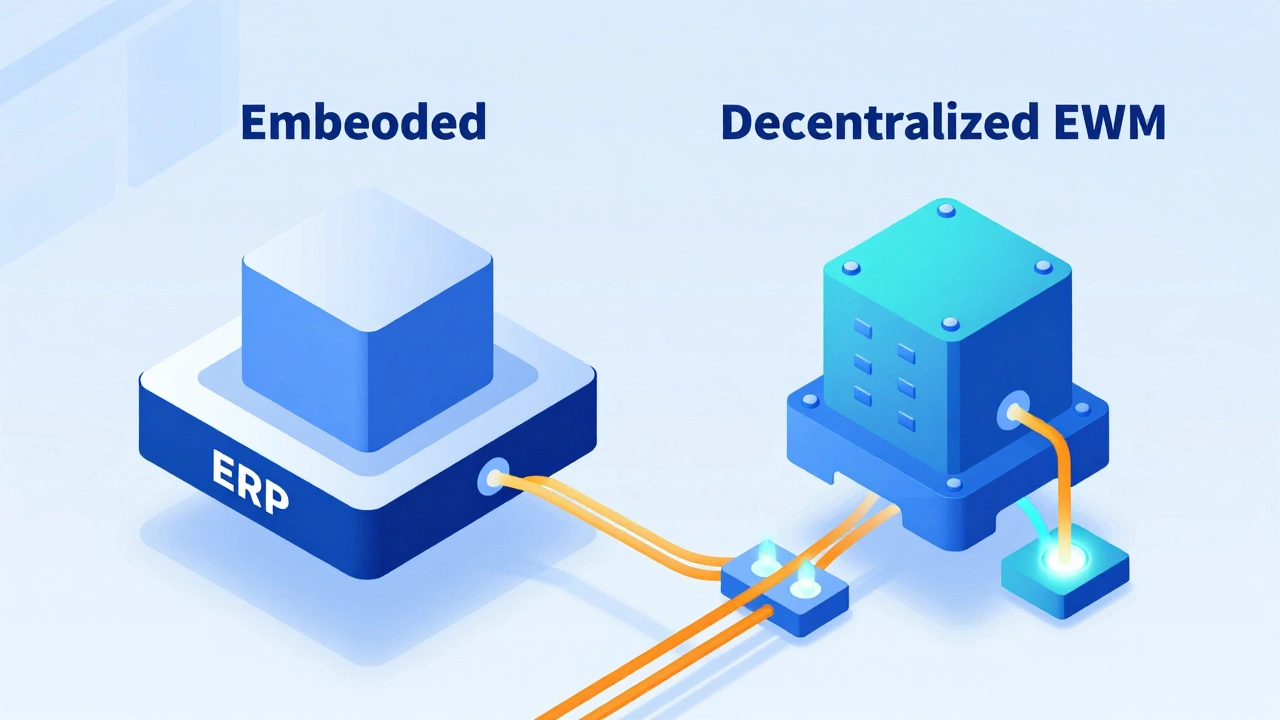
To understand whether SAP fits your needs, you first need to know that "SAP Warehouse Management" isn't one single product. It’s a spectrum. On one end, you have embedded functionality within SAP S/4HANA. On the other, you have SAP Extended Warehouse Management (SAP EWM), which is a dedicated, heavy-duty solution.
Embedded SAP EWM lives inside your core financial and operational ledger. It’s great if your warehouse operations are straightforward-think simple put-away and picking without much automation. You don’t need extra servers or complex integration layers because it talks directly to your general ledger. However, it lacks the granular control required for modern, high-speed fulfillment centers.
Then there’s Decentralized SAP EWM. This is a separate application that connects to your ERP via middleware. It’s built for complexity. If you run cross-docking, wave management, labor optimization, or automated storage and retrieval systems (AS/RS), this is the engine you need. It handles thousands of transactions per minute without slowing down your financial reporting.
What Exactly Can SAP EWM Do?
If you decide to go with the full-power version, SAP EWM brings a specific set of capabilities that generic warehouse management systems often struggle to match. Let’s break down what it actually does on the floor.
- Slotting Optimization: SAP uses algorithms to determine the best location for each SKU based on velocity, size, and weight. It tells you exactly where to move items to minimize picker travel time.
- Wave Management: Instead of picking orders as they come in, SAP groups them into "waves" based on carrier cut-off times, priority, or shipping method. This reduces chaos during peak hours.
- Labor Activation and Monitoring: The system tracks how long tasks take. It identifies bottlenecks and helps managers balance workloads across shifts.
- RFID and Barcode Integration: SAP supports multiple scanning technologies. You can use handheld RF guns, wearable scanners, or even RFID gates for bulk receiving.
- Yard Management: Before goods even enter the door, SAP can manage truck appointments, dock scheduling, and trailer assignments to prevent congestion.
These features aren’t just nice-to-haves; they are critical for companies handling more than 10,000 lines per day. For smaller operations, however, this level of detail might feel like overkill.
SAP EWM vs. Traditional WMS: The Real Trade-Offs
Many people ask if SAP is better than competitors like Blue Yonder, Manhattan Associates, or HighJump. The truth depends on your existing tech stack. Here is how SAP compares to traditional warehouse management solutions.
| Feature | SAP EWM | Traditional WMS (e.g., Blue Yonder) |
|---|---|---|
| ERP Integration | Native (if using SAP ERP) | Requires API/Middleware |
| Implementation Cost | High ($500k - $2M+) | Medium ($100k - $500k) |
| Complexity Handling | Excellent for global, multi-site | Strong for single-site focus |
| User Interface | Fleet UI / Fiori (Modern but rigid) | Often more customizable |
| Total Cost of Ownership | Higher due to licensing & consulting | Lower initial entry barrier |
The biggest advantage of SAP EWM is not its warehouse features-it’s its connection to finance. When a pallet moves in SAP EWM, the cost of goods sold updates in real-time. With a third-party WMS, you often face data latency or reconciliation errors between the warehouse system and your accounting books. For CFOs, this visibility is worth the premium.
However, flexibility is where traditional WMS providers win. They are often easier to customize for unique industry workflows, such as cold chain pharmaceuticals or hazardous materials, without needing deep SAP development skills.
Who Should Actually Use SAP for Warehouse Management?
Not every company needs SAP EWM. In fact, most shouldn’t. Here is a quick heuristic to help you decide.
If you already run SAP S/4HANA or SAP ECC, the decision is easier. Migrating to SAP EWM keeps your data model unified. You avoid the nightmare of maintaining interfaces between two disparate systems. If you are an SAP shop, staying in the SAP ecosystem usually makes sense, provided your budget allows for it.
If you do *not* use SAP ERP, think twice. Implementing SAP EWM as a standalone warehouse system is expensive and complex. You’ll need robust middleware (like SAP PI/PO or CPI) to connect it to your non-SAP ERP. Unless you have extremely complex logistics requirements that outgrow cheaper alternatives, a dedicated WMS like Fishbowl, NetSuite WMS, or Oracle WMS Cloud might serve you better.
Consider these red flags for skipping SAP EWM:
- Your team has less than 50 warehouse employees.
- You handle fewer than 5,000 SKUs.
- Your primary pain point is simple inventory visibility, not process optimization.
- You lack internal SAP technical expertise.
The Implementation Reality Check
Buying the software is only 30% of the battle. Implementing SAP EWM is notoriously difficult. Why? Because it requires precise configuration of business processes that many warehouses haven’t documented properly.
You need to define storage types, activity areas, and picking strategies in extreme detail. A common mistake is trying to replicate old, inefficient paper-based processes in the new digital system. Don’t do that. Use the implementation as a chance to redesign your workflow. Lean Six Sigma methodologies are often applied during SAP EWM rollouts to streamline operations before configuring the software.
Expect a timeline of 6 to 18 months for a full decentralized deployment. Embedded deployments can be faster, sometimes under 6 months, but still require significant change management. Your warehouse staff will resist at first. The interface changes how they interact with their jobs. Training isn’t optional; it’s mandatory for success.

Future-Proofing: SAP Digital Supply Chain
SAP isn’t standing still. The future of warehouse management lies in SAP Digital Supply Chain. This includes AI-driven demand sensing and robotic process automation. SAP EWM integrates with SAP Transportation Management (TM) to create a seamless flow from dock to delivery.
Moreover, SAP is investing heavily in cloud-native architectures. While legacy SAP EWM was on-premise, newer versions leverage hybrid cloud models. This means you get scalability without managing physical servers. If you plan to scale globally, this cloud readiness is a significant advantage over older, monolithic WMS platforms.
Bottom Line: Is It Worth It?
Does SAP do warehouse management? Yes, exceptionally well-but only if you speak its language and have the resources to support it. For large enterprises deeply embedded in the SAP ecosystem, EWM is arguably the gold standard for integrated logistics. For mid-market companies or those outside the SAP world, it may be an over-engineered solution that drains your budget without delivering proportional value.
Before committing, audit your current warehouse processes. Map out your pain points. Then, weigh the cost of integration against the benefit of real-time financial visibility. If the math works, SAP EWM can transform your warehouse from a cost center into a competitive advantage.
Is SAP EWM included in standard SAP ERP licenses?
No, SAP EWM is typically an additional license. While basic inventory management is part of SAP MM (Materials Management), extended warehouse management features require a separate purchase. Embedded EWM is included in some S/4HANA editions, but decentralized EWM always carries an extra cost.
Can I use SAP EWM with a non-SAP ERP system?
Yes, through decentralized deployment. However, this requires robust middleware integration to sync data between your ERP and SAP EWM. It adds complexity and maintenance overhead compared to native SAP integrations.
How long does it take to implement SAP EWM?
Implementation timelines vary widely. Simple embedded deployments can take 3-6 months. Complex decentralized implementations with automation integration often take 12-24 months. Proper project scoping and user training are critical to avoiding delays.
What is the difference between SAP WM and SAP EWM?
SAP WM (Warehouse Management) is the older, legacy module within SAP ECC. SAP EWM (Extended Warehouse Management) is the modern replacement with advanced features like labor optimization, yard management, and better UI. SAP recommends migrating from WM to EWM for new projects.
Is SAP EWM suitable for small businesses?
Generally, no. SAP EWM is expensive and complex. Small businesses with simpler logistics needs should consider lighter-weight WMS solutions like Fishbowl, Odoo, or NetSuite WMS, which offer faster deployment and lower total cost of ownership.
Does SAP EWM support mobile devices?
Yes, SAP EWM supports various mobile devices including RF guns, smartphones, and tablets via the SAP Fiori interface or custom-built apps. This allows warehouse workers to perform tasks like picking, putaway, and cycle counting on the go.