
Warehouse Software Stack Analyzer
How it works: Answer a few questions about your current or planned warehouse operations. This tool will analyze your requirements against industry standards to recommend the specific software layers you need.
Operational Details
Recommended Software Stack
Strategic Insight
Enter your details and click "Analyze" to generate your custom software recommendation.
You walk into a modern distribution center. It’s quiet. There are no shouting managers, no stacks of paper clipboards, and no frantic searches for misplaced boxes. Instead, you see workers moving with purpose, guided by handheld scanners or wearable devices, while robots glide silently across the floor. What makes this possible isn’t just good training-it’s software. The right digital tools turn chaos into order.
But what exactly is running behind the scenes? If you’re looking to upgrade your operations or simply trying to understand how these facilities function, knowing which warehouse management software and related technologies are standard today is crucial. This isn't about picking one app; it's about understanding an ecosystem of tools that talk to each other to keep goods moving from receipt to delivery.
The Brain: Warehouse Management Systems (WMS)
At the heart of any sophisticated warehouse lies the Warehouse Management System, or WMS, which is software designed to optimize daily warehouse operations including receiving, putaway, storage, picking, packing, and shipping. Think of the WMS as the central nervous system. Without it, a warehouse is just a big room with shelves. With it, every inch of space and every minute of labor is accounted for.
A robust WMS tracks inventory in real-time. When a pallet arrives, the system tells the worker exactly where to place it based on velocity, size, and compatibility. When an order comes in, it calculates the most efficient path for pickers to gather items, reducing walking time-which can account for up to 50% of a picker's shift. Major players like Blue Yonder, Manhattan Associates, and SAP EWM dominate this space, offering deep customization for complex environments.
- Receiving & Putaway: Automates the assignment of locations for incoming goods, ensuring fast-moving items are easily accessible.
- Picking Optimization: Uses algorithms to batch orders and direct workers via voice, light, or RF scanners to minimize travel.
- Inventory Accuracy: Maintains cycle counting schedules and reconciles discrepancies instantly, often achieving 99.9% accuracy rates.
The Muscle: Warehouse Control Systems (WCS) and Automation
If the WMS is the brain, the Warehouse Control System (WCS) is the middleware that connects high-level warehouse management software with physical automation hardware. As warehouses become more automated, the gap between "what needs to happen" and "how the machine does it" widens. The WCS bridges that gap.
Modern warehouses increasingly rely on automated storage and retrieval systems (AS/RS), conveyor belts, sorters, and autonomous mobile robots (AMRs). The WCS translates the WMS's instruction-"Pick Item A from Location B"-into specific commands for the machinery. For example, it might tell a robot to navigate to aisle 4, lift a bin, and bring it to a stationary workstation. Companies like Locus Robotics and Geek+ provide the robotic fleet management software that integrates seamlessly here.
This layer is critical because hardware doesn't think strategically; it executes tasks. The WCS ensures that if a conveyor jams or a robot runs low on battery, the workflow reroutes automatically without human intervention, keeping throughput stable even during hiccups.
The Transport Layer: Transportation Management Systems (TMS)
Once goods are packed and labeled, they need to leave the building. This is where the Transportation Management System (TMS) takes over. While the WMS focuses on internal movement, the TMS optimizes the movement of goods from the warehouse to the customer or next facility.
A TMS helps select the best carrier, negotiate rates, and plan routes. It integrates with the WMS so that as soon as a shipment is created internally, the TMS books the truck or labels the parcel. Popular solutions include Oracle TMS, Project44, and cloud-native options like Freightos.
In 2026, visibility is king. Shippers demand real-time tracking, not just at the pickup point but throughout the transit journey. Advanced TMS platforms use telematics data from trucks to predict delays due to traffic or weather, allowing warehouses to adjust staffing or inform customers proactively. This seamless handoff between WMS and TMS eliminates the "black hole" period where goods disappear after leaving the dock.
| Software Type | Primary Function | Key Users | Integration Point |
|---|---|---|---|
| WMS | Internal inventory & labor management | Warehouse Managers, Pickers | ERP, WCS, TMS |
| WCS | Hardware automation control | Automation Engineers | WMS, PLCs, Robots |
| TMS | Outbound shipping & carrier selection | Logistics Coordinators | WMS, Carrier APIs |
| ERP | Financials & overall business planning | CFOs, Procurement | WMS, CRM |
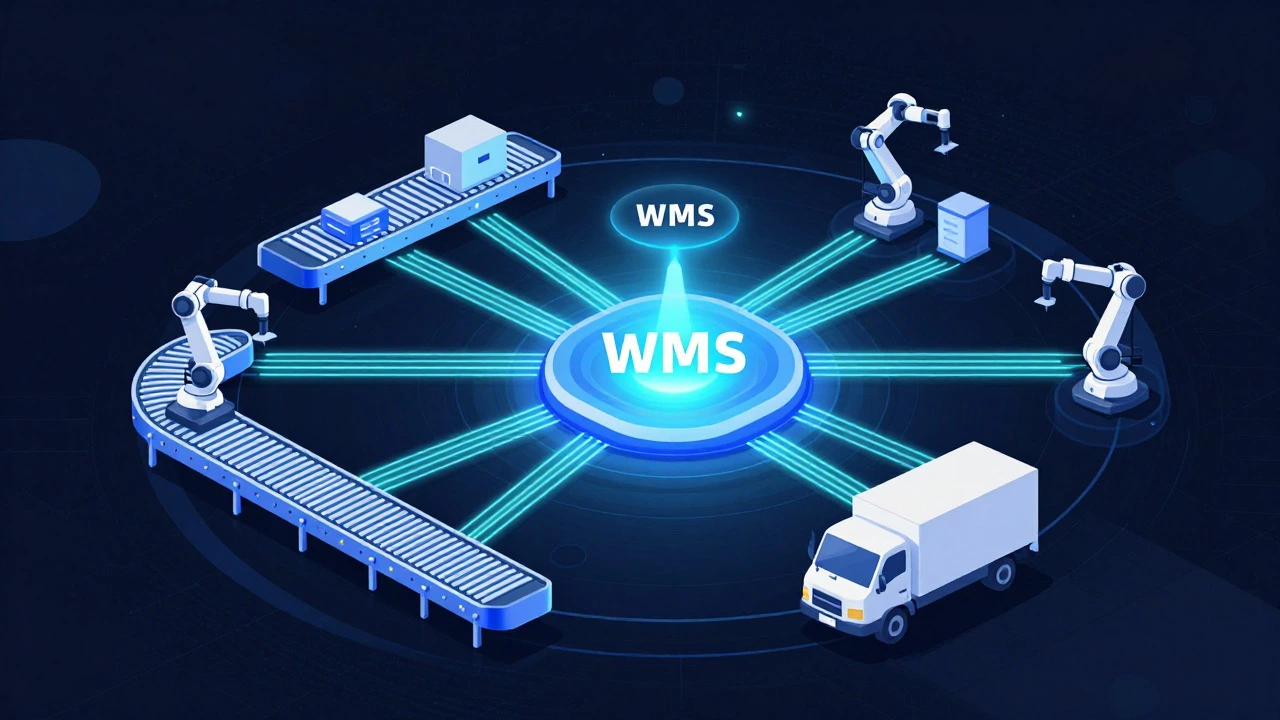
The Foundation: Enterprise Resource Planning (ERP)
You can't run a warehouse in a vacuum. Every box moved has a financial cost, a supplier origin, and a customer destination. This broader context is managed by Enterprise Resource Planning (ERP) software, such as SAP S/4HANA, Oracle NetSuite, or Microsoft Dynamics 365. The ERP acts as the single source of truth for the entire business.
While a dedicated WMS handles the granular details of *where* a SKU is sitting on a shelf, the ERP tracks *why* it's there, how much it costs, and when it was purchased. In smaller operations, the ERP might have a basic warehouse module that suffices. But as volume grows, the ERP becomes too slow and clunky for real-time warehouse execution. That’s why large enterprises decouple their WMS from their ERP, connecting them via API integrations to ensure speed and accuracy.
The Eyes: IoT, RFID, and Scanning Technology
Software is only as good as the data fed into it. Garbage in, garbage out. To ensure data integrity, warehouses rely heavily on Internet of Things (IoT) devices and identification technologies.
Traditional barcodes are still the workhorse, scanned via ruggedized handheld terminals or fixed-mount scanners. However, Radio Frequency Identification (RFID) is a wireless technology that uses electromagnetic fields to automatically identify and track tags attached to objects. Unlike barcodes, RFID doesn't require line-of-sight scanning. You can walk through a doorway with a cart full of boxes, and an RFID gate will read all tags simultaneously. This drastically speeds up receiving and cycle counting processes.
Sensors also play a role. Temperature and humidity sensors monitor conditions for perishable goods, sending alerts to the WMS if thresholds are breached. Wearable technology, like smart gloves or ring scanners, allows workers to keep their hands free while interacting with the software, boosting both safety and efficiency.
Choosing the Right Stack for Your Business
Selecting software isn't a one-size-fits-all decision. A small e-commerce startup handling 100 orders a day has different needs than a pharmaceutical distributor managing millions of temperature-sensitive units. Here is how to approach the choice:
- Assess Complexity: Do you need simple stock tracking, or do you manage kits, serial numbers, and expiry dates? Complex requirements demand a full-featured WMS.
- Consider Scalability: Cloud-based SaaS solutions offer faster deployment and easier scaling compared to on-premise servers. They also handle updates automatically, which is vital in a rapidly changing tech landscape.
- Check Integrations: Ensure the software plays nice with your existing ERP, e-commerce platform (like Shopify or Magento), and carrier services. Poor integration leads to manual data entry errors.
- Evaluate User Experience: The best software is useless if workers hate using it. Look for intuitive interfaces, voice-picking capabilities, and minimal training curves.
Don't forget about Total Cost of Ownership (TCO). Cheap software often hides costs in implementation fees, mandatory consultants, or poor support. Premium vendors may charge more upfront but deliver ROI through reduced labor costs and fewer shipping errors within the first year.
The Future: AI and Predictive Analytics
We are moving beyond reactive software to predictive intelligence. Modern warehouse platforms now incorporate Artificial Intelligence (AI) and Machine Learning (ML) to forecast demand spikes before they happen. Imagine your software telling you three weeks in advance that you’ll need double the packing staff next month because of a predicted sales surge based on historical data and current market trends.
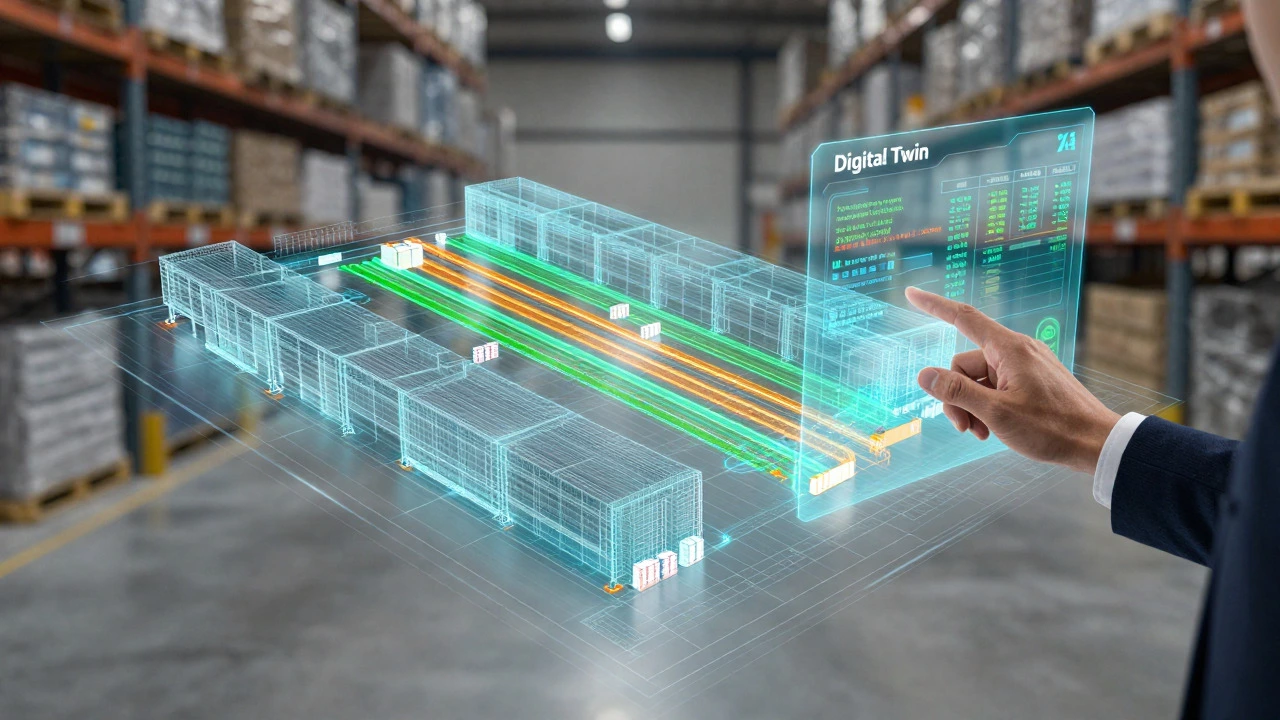
Digital Twins are also gaining traction. A Digital Twin is a virtual replica of your physical warehouse. By simulating changes-like adding new conveyors or altering picking paths-in the virtual model, managers can test scenarios without disrupting actual operations. This reduces risk and accelerates optimization cycles.
Is Excel enough for warehouse management?
For very small operations with fewer than 50 SKUs and minimal transaction volume, Excel might suffice initially. However, it lacks real-time synchronization, error-checking, and scalability. Once you experience stockouts due to inaccurate counts or miss shipments because of manual data entry errors, upgrading to dedicated WMS software becomes a financial necessity rather than a luxury.
What is the difference between WMS and ERP?
An ERP manages the entire business, including finance, HR, and procurement, providing a high-level view of inventory value. A WMS focuses specifically on the physical movements inside the four walls of the warehouse. While ERPs track *that* you have 100 units, a WMS tracks *exactly* where those 100 units are located down to the bin level and directs workers to retrieve them efficiently.
How long does it take to implement warehouse software?
Implementation timelines vary widely. Simple cloud-based WMS solutions can be live in 4-8 weeks with minimal customization. Complex, on-premise systems involving heavy automation integration and custom workflows can take 6-12 months or longer. Proper data migration and staff training are critical phases that should never be rushed.
Do I need a Warehouse Control System (WCS)?
You only need a WCS if you operate significant material handling automation, such as AS/RS, conveyors, or sorters. If your warehouse relies primarily on manual labor with some assistive technology like voice picking, a robust WMS with built-in device management is usually sufficient. The WCS adds a necessary layer of complexity only when machines are involved.
Can warehouse software integrate with e-commerce platforms?
Yes, almost all modern WMS solutions offer native integrations or API connections with major e-commerce platforms like Shopify, WooCommerce, Amazon Seller Central, and Magento. This ensures that online orders flow directly into the warehouse queue for processing, and inventory levels update automatically on your storefront to prevent overselling.