Logistics Cost Calculator
Calculate Your Shipping Cost
See how pricing factors like weight, delivery urgency, and special services affect your logistics costs.
Cost Breakdown
Insight: Your calculation shows how logistics companies combine multiple pricing layers to create value. Note how the same shipment could cost $120 with basic services versus $350 with premium options.
Most people think logistics companies just move boxes from point A to point B. But if that were all they did, none of them would stay in business. The truth is, logistics companies make money by solving complex, high-stakes problems - and charging for the expertise, infrastructure, and risk they absorb along the way.
It’s Not About the Truck, It’s About the Network
A single delivery truck doesn’t generate profit. A network of 500 trucks, 12 warehouses, real-time tracking software, and a team of dispatchers who can reroute shipments during a storm? That’s where the money is.
Logistics companies don’t just own trucks. They own relationships - with carriers, ports, customs brokers, and even competitors. When a retailer in Auckland needs to ship 10,000 units of winter gear to Wellington, they don’t call a trucking company. They call a logistics provider who already has contracts with rail operators, regional haulers, and last-mile couriers. The logistics company bundles all those pieces together and sells the whole solution as one seamless service.
This is called asset-light model - meaning they don’t need to own every vehicle or warehouse. They control the flow. And that control is what lets them charge premium rates.
How They Price Their Services
Logistics pricing isn’t like buying a coffee. It’s not just distance × fuel cost. There are layers.
- Weight and volume - Heavy or bulky items cost more, even if they’re short-distance. A pallet of bottled water takes up space and adds strain to a trailer.
- Freight class - In the U.S. and New Zealand, goods are assigned a class from 50 to 500 based on density, handling difficulty, and liability. A fragile glass sculpture? Class 500. Steel pipes? Class 70. Higher class = higher price.
- Delivery windows - If you need a shipment delivered between 9 a.m. and 11 a.m. on a Tuesday, you pay extra. Standard delivery? Cheaper. Same-day? Double or triple the cost.
- Fuel surcharges - When diesel hits $2.10 per liter, that gets passed on. But logistics companies don’t just react - they lock in fuel contracts months ahead to stabilize pricing.
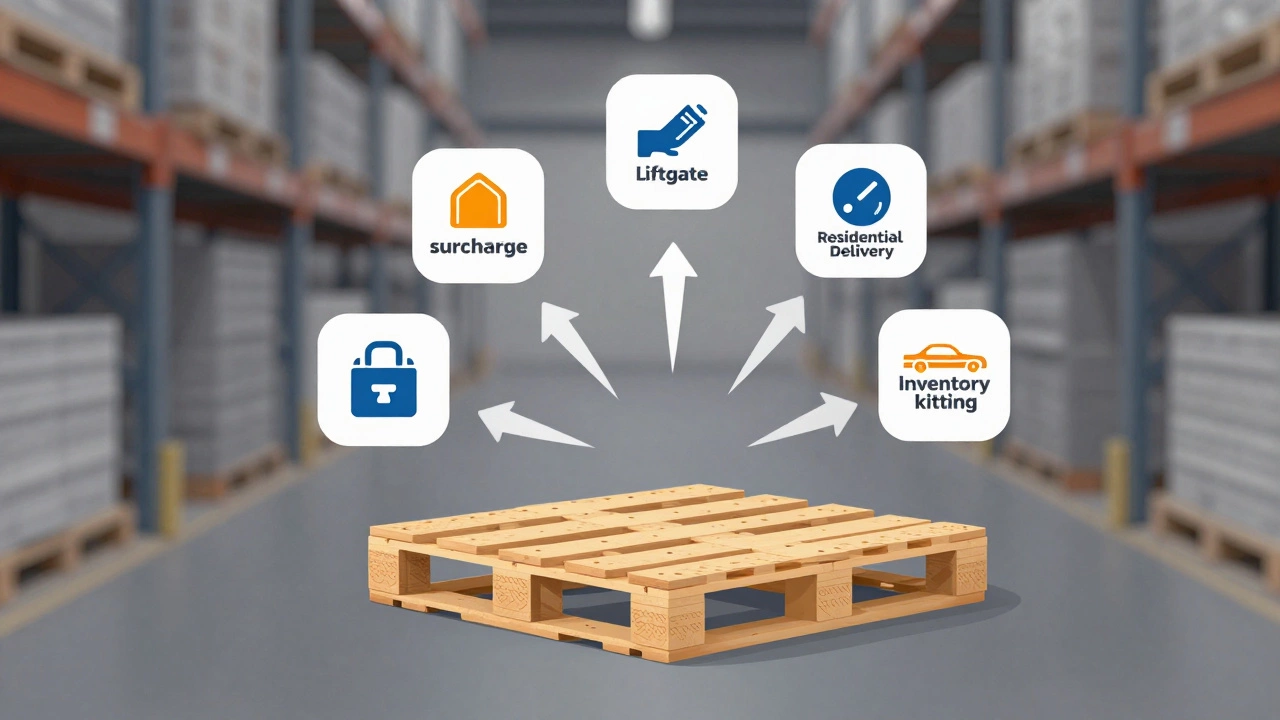
- Accessorial fees - Liftgate service? $75. Residential delivery? $50. Inside delivery? Another $60. These add up fast.
Think of it like a restaurant menu. Basic delivery is the burger. Special handling? That’s the truffle fries - same core service, but with premium add-ons.
Profit Comes From Volume, Not Single Shipments
A single package might earn a logistics company $2.50. But if they move 20,000 packages a day across 12 cities? That’s $50,000 in daily revenue - and that’s just from one client.
Big logistics firms like DHL, FedEx, or local players like NZ Post and CourierPost don’t rely on one-off customers. They lock in long-term contracts with e-commerce brands, manufacturers, and retailers. These contracts guarantee minimum monthly volumes - sometimes hundreds of thousands of shipments.
Here’s the trick: they price those contracts just high enough to cover costs and leave room for profit, but low enough that the client doesn’t switch. Then they use that guaranteed volume to negotiate better rates with carriers, fuel suppliers, and warehouse landlords. The bigger the volume, the lower their cost per unit - and the wider their margin.
Warehousing Is a Hidden Cash Machine
Most people don’t realize that warehousing is often more profitable than transportation.
Think about it: a warehouse costs $1.5 million to build. But once it’s running, the monthly operating cost is mostly labor and utilities. The real profit? Storage fees. A client pays $20 per pallet per month. If you have 5,000 pallets in storage? That’s $100,000 a month - just from sitting there.
Plus, warehouses offer value-added services: labeling, kitting, returns processing, inventory management. These aren’t free. A company like The Warehouse Group might pay $5 extra per unit to have their products labeled for retail shelves. That’s pure margin.
And here’s the kicker: warehouses often hold inventory for multiple clients. One pallet might belong to a skincare brand, the next to a toy distributor. The logistics company doesn’t just store it - they optimize the space, rotate stock, and reduce waste. That’s consulting, wrapped in a warehouse.
Technology Is the Silent Profit Engine
Logistics companies aren’t just moving stuff. They’re moving data.
Real-time tracking, automated routing, predictive delay alerts - these aren’t just for customer service. They’re profit tools. A system that reduces empty miles by 15% means 15% less fuel, 15% less driver hours, and 15% more deliveries per day.
Companies like FourKites or project44 give logistics firms visibility into every leg of a shipment. That means they can proactively fix delays before the customer even notices. And when you can promise 99.5% on-time delivery? You charge 20% more than the competitor who’s always late.
And don’t forget the software they sell. Many logistics firms now offer their own TMS (Transportation Management System) as a subscription service. A small business pays $200/month to manage their own shipments through the logistics company’s platform. That’s recurring revenue - with near-zero marginal cost.
Risk Management Pays Off
What happens when a shipment gets stuck at customs? When a truck breaks down in the middle of the Southern Alps? When a warehouse catches fire?
Most small carriers fold under that kind of pressure. Logistics companies don’t. They absorb the cost - and charge for it.
They buy cargo insurance in bulk, negotiate lower premiums, and pass the savings to clients while keeping a healthy spread. They offer guaranteed delivery windows - and pay penalties if they miss them. That sounds like a cost. But it’s actually a pricing lever. Clients pay more for that guarantee because they know the logistics company has the systems to back it up.
They also manage compliance. Import/export paperwork, dangerous goods regulations, biosecurity rules - especially critical in New Zealand. Getting it wrong means fines, delays, or seized goods. Logistics firms charge extra to handle this because they’ve got specialists on staff who know exactly what to file, when, and how.
Who Makes the Most Money?
Not the drivers. Not the warehouse workers. The companies that control the ecosystem.
Big global players like DHL and UPS make money through scale and technology. Regional players like NZ Post profit from monopoly-like access to rural routes and government contracts. Niche firms - like those specializing in cold chain logistics for pharmaceuticals - make money because there’s no one else who can do it safely.
The most profitable logistics companies aren’t the ones with the biggest fleets. They’re the ones who solve problems others can’t - or won’t.

Why Small Logistics Firms Struggle to Survive
There are thousands of small trucking companies in New Zealand. Most are family-run. They have one or two trucks, one driver, and one client.
They make money on volume, but they can’t scale. They can’t negotiate fuel discounts. They don’t have software to optimize routes. And when a client demands real-time tracking or same-day delivery? They can’t deliver.
That’s why 70% of small freight operators in New Zealand either shut down or get bought out within five years. The big players don’t just outcompete them - they make the rules of the game.
The Future: Profit From Data, Not Just Distance
The next wave of profit won’t come from moving more boxes. It’ll come from knowing what’s inside them - and predicting what happens next.
Logistics companies are starting to sell analytics. They can tell you which products sell fastest in which regions. They know which routes are congested during holiday seasons. They track supplier delays before they happen.
One Auckland-based logistics firm now offers a monthly report to its e-commerce clients: ‘Your Top 3 Slow-Moving SKUs’ and ‘Best Time to Replenish’. That’s not logistics. That’s supply chain consulting. And they charge $1,000 a month for it.
Soon, the biggest profit center won’t be the truck. It’ll be the algorithm.
Do logistics companies make money from fuel surcharges?
Yes, but not directly. Fuel surcharges are meant to cover rising diesel costs, not boost profit. However, logistics companies lock in fuel contracts at fixed rates. When market prices rise, they absorb the difference and charge clients the surcharge. When prices drop, they keep the savings. That’s how they turn fuel volatility into stable margins.
Is warehousing more profitable than shipping?
Often, yes. Shipping has high variable costs - fuel, drivers, maintenance. Warehousing has high upfront costs but low ongoing expenses. Once a warehouse is full, each additional pallet adds almost nothing to the cost. Storage fees, kitting services, and inventory turnover generate steady, high-margin revenue.
Can a small logistics company compete with giants like DHL?
Not head-on. But they can win by specializing. Think cold chain for medical supplies, hazardous materials transport, or same-day delivery in a single city. Giants can’t be experts in everything. Niche players who solve one problem extremely well often outperform them in their segment.
How do logistics companies handle returns?
Returns are a hidden profit center. Instead of sending items back to the original warehouse, logistics firms set up dedicated return centers. They inspect, sort, repackage, and resell. Some even refurbish items. E-commerce brands pay them per return processed - and sometimes even for the value recovered from the returned goods.
What’s the average profit margin for a logistics company?
It varies widely. Small regional operators might make 5-8%. Large national firms with tech and warehousing can hit 12-18%. Global players like DHL or FedEx average around 9-11%. The most profitable ones - those with software, automation, and data services - can push past 20%.
What Should You Do If You’re in Logistics?
If you run a small logistics business, stop competing on price. Start competing on reliability, visibility, and service depth. Add warehousing. Add tracking. Add returns management. Even one value-added service can double your revenue per client.
If you’re a client hiring a logistics company, don’t just ask for the lowest quote. Ask: ‘What happens if my shipment is delayed?’ ‘Do you have backup carriers?’ ‘Can you track inventory in real time?’ The answer tells you who’s really making money - and who’s just moving boxes.