Logistics Salary & Career Path Estimator
Estimated Market Value
Think the logistics world is just about driving trucks and scanning barcodes in a chilly warehouse? Think again. If you're wondering if it's possible to hit that $100,000 mark, the short answer is a resounding yes. But it doesn't happen by accident. The industry has shifted from a 'back-office' function to a strategic powerhouse. In today's world, the person who can move a product from a factory in Vietnam to a doorstep in New York faster and cheaper than the competition is worth their weight in gold.
Key Takeaways for Aspiring High-Earners
- Six-figure salaries are common in senior management, specialized technology roles, and strategic planning.
- The fastest path to $100k+ usually involves moving from tactical execution to strategic oversight.
- Certifications like CSCP and Six Sigma often act as catalysts for salary jumps.
- High-demand niches include cold chain logistics, pharmaceutical supply chains, and AI-driven warehouse automation.
Where the Big Money Actually Sits
You won't hit six figures as an entry-level dispatcher or a warehouse associate. To get there, you need to move into roles that manage risk, spend, and complex systems. The most consistent six-figure roles usually fall into three buckets: corporate leadership, specialized consultancy, and high-tech operations.
Take Supply Chain Management is the overarching process of planning, implementing, and controlling the efficient flow of goods and services across a network. A Director of Supply Chain isn't just worrying about today's shipments; they are predicting demand for the next three years. When you manage a budget of $50 million in procurement, a salary of $150,000 looks like a bargain to the company.
Then there are the operational heavy-hitters. A Logistics Manager is a professional responsible for coordinating the movement of goods, managing carrier relationships, and optimizing warehouse efficiency. While a mid-level manager might make $70,000, a Regional Logistics Director overseeing ten distribution centers across the Midwest easily clears $120,000 to $180,000. The scale of responsibility is what drives the paycheck.
The Fast Track: How to Climb the Ladder
If you're currently making $45,000 and want to hit $100,000, you can't just wait for annual 3% raises. You need to pivot your skill set. Most people get stuck in the "execution trap"-they are so good at fixing today's problems that they never learn how to prevent tomorrow's.
Start by mastering the data. If you can use SQL or advanced Tableau to show a VP exactly where the company is losing 4% of its margin due to inefficient "deadhead" miles, you become indispensable. You're no longer a cost center; you're a profit generator.
Education also plays a role, but a fancy degree is often less valuable than a specific certification. For example, getting a CSCP (Certified Supply Chain Professional) designation proves you understand the end-to-end global flow. Combine that with a Six Sigma Black Belt-which focuses on eliminating defects and waste-and you have the credentials to demand a senior role.
| Role | Experience | Avg Salary Range | Key Skill Required |
|---|---|---|---|
| Logistics Coordinator | 0-3 Years | $45k - $65k | Organization & Coordination |
| Operations Manager | 5-8 Years | $75k - $110k | Team Leadership & P&L Management |
| Supply Chain Director | 10+ Years | $130k - $190k | Strategic Planning & Risk Mitigation |
| VP of Global Logistics | 15+ Years | $200k+ | Executive Leadership & Board Relations |

High-Paying Niches You Should Consider
Not all logistics roles are created equal. If you want to reach six figures faster, look for "high-friction" industries. High friction means the stakes are higher, the regulations are tighter, and the cost of failure is catastrophic. That's where the money is.
Consider Cold Chain Logistics, which is a temperature-controlled supply chain that ensures perishable products stay within a specific temperature range. If a freezer breaks in a standard warehouse, you lose some cardboard boxes. If a cold chain fails for a shipment of mRNA vaccines, you lose millions of dollars and potentially human lives. Companies pay a premium for experts who can guarantee this level of precision.
Another goldmine is Third-Party Logistics (3PL). A 3PL provider is a company that provides outsourced logistics services to other businesses. Working for a giant 3PL allows you to see how ten different industries operate. This versatility makes you an incredibly attractive candidate for high-paying internal roles at major retailers or manufacturers.
The Shift Toward Logistics Technology
We're seeing a massive surge in pay for those who bridge the gap between traditional trucking and software. The industry is moving away from spreadsheets and toward Transportation Management Systems (TMS). A TMS is a platform used to plan, execute, and optimize the movement of goods. If you can implement a new TMS across a global fleet, you aren't just a "logistics guy" anymore-you're a systems architect.
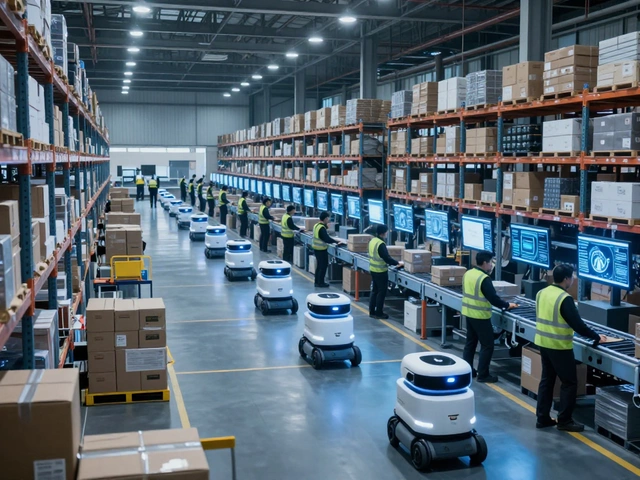
Automation is the other big driver. Companies are investing billions into Warehouse Management Systems (WMS) and robotics. The person who can integrate an autonomous mobile robot (AMR) fleet into a legacy warehouse environment is currently seeing salaries that rival senior software engineers. Why? Because they possess the rare combination of "dirt-under-the-fingernails" operational experience and high-level technical fluency.

Pitfalls That Keep You Under 0k
Why do some people spend 20 years in logistics and never hit six figures? Usually, it's because they become the "reliable fixer." When you are the only person who knows how to handle the chaotic Friday afternoon rush, your boss has every incentive to keep you exactly where you are. You've become too valuable in your current role to be promoted.
To break this cycle, you have to delegate. Start training your replacement. When you can show your manager that the warehouse runs perfectly even when you aren't there, you've proven that you're ready for a role that focuses on growth rather than firefighting. The shift from "doing the work" to "designing the work" is the fundamental requirement for a high-salary jump.
Another trap is staying at the same company for too long. In logistics careers, the biggest salary jumps happen during the first move after a major achievement. If you've just saved your company $2 million by renegotiating carrier contracts, that's the moment your market value is at its peak. If the internal promotion doesn't happen, the external market will usually pay a 20-30% premium to steal that expertise.
Do I need a Master's degree to make 6 figures in logistics?
Not necessarily, but it helps for the highest executive levels. An MBA or a Master's in Supply Chain Management can open doors to VP roles. However, many people hit $100k+ through a combination of a Bachelor's degree, a few high-value certifications (like CSCP), and a track record of saving companies money through operational efficiency.
Which certifications are most valued for salary increases?
The most recognized certifications include the APICS CSCP (Certified Supply Chain Professional), CLTD (Certified in Logistics, Transportation and Distribution), and Six Sigma belts (Green or Black). These prove you have a standardized methodology for solving problems, which reduces the risk for a company hiring you for a high-paying leadership role.
Is it easier to make 6 figures in a 3PL or an in-house role?
Both have paths to six figures, but the trajectories differ. 3PLs often offer faster climbs because you're exposed to multiple clients and industries quickly. In-house roles (working for a manufacturer or retailer) often have higher ceilings for executive leadership (C-suite) because you are managing the core business's primary cost centers.
What soft skills are required for high-paying logistics roles?
Negotiation is the biggest one. Whether you're dealing with shipping lines, trucking companies, or vendors, the ability to shave 2% off a contract can equal millions in profit. Additionally, strategic communication-the ability to explain a complex supply chain bottleneck to a CEO who doesn't know what a pallet is-is what separates managers from executives.
How does location affect logistics salaries?
Hub cities with major ports or rail terminals (like Memphis, Long Beach, or Rotterdam) typically offer higher salaries due to the concentration of activity and competition for talent. However, remote roles in logistics consultancy and supply chain design are becoming more common, allowing experts to command high salaries regardless of their physical location.
Next Steps for Your Salary Growth
If you're ready to move up, don't start by asking for a raise. Start by building a "Wins Folder." Document every time you reduced lead time, lowered shipping costs, or implemented a new software tool. Quantify everything: "Reduced warehouse waste by 12%" sounds much better than "Improved warehouse efficiency." Use these metrics in your annual review or on your resume to prove you're providing six-figure value.
For those just starting, focus on the "cross-train." Spend a month in the warehouse, a month in procurement, and a month in transportation. The people who make the most money in this industry are those who understand how a mistake in the purchasing department creates a nightmare for the delivery driver three weeks later. That holistic view is where the real value lies.